Responsible Disclosure — Open Bug Bounty Outstanding Security Research Award
Summary of my responsible disclosure work reporting reflected XSS and open redirect issues (CVE-2021-32478) across education and learning sites worldwide, coordinated via Open Bug Bounty.
Legal / ethical reminder: Misusing these techniques against systems without permission is illegal. All findings described below were reported responsibly and remediated where possible.
Executive summary
Between September and November 2023 I ran a coordinated responsible-disclosure effort focused on web issues in education and learning platforms. Over the course of this work, I reported over 600 issues through Open Bug Bounty and related channels; my coordinated discoveries contributed to 151+ verified fixes acknowledged by Open Bug Bounty.
I did not receive monetary bounties from Open Bug Bounty for this work, the value was in learning, coordinating fixes, and helping keep student data safer.
Interactive map
Asif Minhas – Responsible Disclosure | Open Bug Bounty 2025
What I found (high level)
The majority of the accepted reports that are accepted by Open Bug Bounty fell into the following five categories:
- Reflected Cross-Site Scripting (XSS)
- Open Redirect
- Cross-Site Request Forgery (CSRF)
- Improper Access Control
- GDPR / PII exposure
I focused on finding:
- Cross-Site Scripting (XSS)
- Open Redirect (typically via
redirect_uriparameters)
My research focused on identifying learning platforms, primarily Moodle instances, that had not applied the security patch for CVE-2021-32478. This 2021 vulnerability combines an open redirect with a reflected XSS in the LTI authentication module (/mod/lti/auth.php), and I found it remained unpatched on hundreds of systems in 2023.
Timeline & approach
- First accepted report on OBB: 2023-09-07
- Last submission in this batch: 2023-11-18
- Method: I used a mix of automated discovery (Shodan, Censys, targeted Google dorks) and custom Python scripts to find candidate targets, then validated results manually to avoid false positives.
GitHub advisory & CVE
- CVE: CVE-2021-32478
- GitHub advisory: GHSA-78fm-qhh8-8858
Proof-of-concept
Note: the examples below are sanitised for public consumption: they use
example.comas a placeholder. Do not publish live PoCs that target active, unpatched systems, always route them through the disclosure process instead.
Reflected XSS:
https://example.com/mod/lti/auth.php?redirect_uri=javascript:alert(%27TEST%27)
https://example.com/mod/lti/auth.php?redirect_uri=javascript:alert(document.domain)
https://example.com/mod/lti/auth.php?redirect_uri=javascript:alert(document.cookie)
Open redirect:
https://example.com/mod/lti/auth.php?redirect_uri=https://google.com
Impact
When combined or used in login/SSO flows, reflected XSS and open redirects can:
- Enable phishing that abuses legitimate looking login redirects
- Exfiltrate session tokens or cookies (depending on same-site policy and CSP)
- Allow attacker controlled scripts to run in the context of an educational site (risking student data or grade disclosure)
Remediation checklist
For developers and IT teams maintaining learning platforms:
- Allowlist redirect URIs — require exact-match redirect URIs per client, avoid accepting arbitrary external URLs.
- Contextual output encoding — never reflect untrusted input without encoding for the context (HTML/attribute/JS).
- CSP & cookie policy — implement CSP and set
SameSite/Secureon session cookies. - Least privilege & access control — verify every file endpoint and resource is properly authorised.
- Automated scanning + triage — run scheduled scans and feed results into a tracked ticketing workflow.
- Disclosure contact — publish a security contact ([email protected]) or a disclosure page to receive reports quickly.
Scope (TLDs / regions) — flags included where applicable
Below is the full list of TLDs I encountered during this research. If a TLD is country specific, I show the corresponding national flag emoji. If the TLD is generic / global, I mark it as Generic.
Note: flag emoji rendering depends on the platform/browser. If the flag does not render for a reader, it will appear as two letters (regional indicator symbols).
Country-Based TLDs with Continents
This vulnerability wasn’t isolated to one region. My research identified and helped secure vulnerable platforms across seven continents. The following tables break down the Top-Level Domains (TLDs) of the affected systems, showing the truly global reach of this responsible disclosure effort.
| Flag | TLD | Country / Region | Continent |
|---|---|---|---|
| 🇬🇧 | .ac.uk | United Kingdom (academic subdomain) | Europe |
| 🇦🇪 | .ae | United Arab Emirates | Middle East |
| 🇦🇮 | .ai | Anguilla (used by AI companies) | North America |
| 🇦🇷 | .ar | Argentina | South America |
| 🇦🇺 | .au | Australia | Australia |
| 🇧🇩 | .bd | Bangladesh | Asia |
| 🇧🇪 | .be | Belgium | Europe |
| 🇧🇭 | .bh | Bahrain | Middle East |
| 🇧🇬 | .bg | Bulgaria | Europe |
| 🇧🇷 | .br | Brazil | South America |
| 🇨🇦 | .ca | Canada | North America |
| 🇪🇸 | .cat | Catalonia (Spain region) | Europe |
| 🇨🇱 | .cl | Chile | South America |
| 🇨🇳 | .cn | China | Asia |
| 🇨🇴 | .co | Colombia | South America |
| 🇬🇧 | .co.uk | United Kingdom | Europe |
| 🇨🇾 | .cy | Cyprus | Europe |
| 🇩🇪 | .de | Germany | Europe |
| 🇪🇨 | .ec | Ecuador | South America |
| 🇪🇸 | .es | Spain | Europe |
| 🇪🇺 | .eu | European Union (regional) | Europe |
| 🇫🇯 | .fj | Fiji | Oceania |
| 🇫🇷 | .fr | France | Europe |
| 🇬🇷 | .gr | Greece | Europe |
| 🇬🇹 | .gt | Guatemala | North America |
| 🇭🇰 | .hk | Hong Kong | Asia |
| 🇭🇺 | .hu | Hungary | Europe |
| 🇮🇴 | .io | British Indian Ocean Territory (tech/startup use) | Asia |
| 🇮🇳 | .in | India | Asia |
| 🇮🇶 | .iq | Iraq | Middle East |
| 🇮🇪 | .ie | Ireland | Europe |
| 🇮🇹 | .it | Italy | Europe |
| 🇯🇴 | .jo | Jordan | Middle East |
| 🇯🇵 | .jp | Japan | Asia |
| 🇰🇿 | .kz | Kazakhstan | Asia |
| 🇲🇦 | .ma | Morocco | Africa |
| 🇲🇪 | .me | Montenegro | Europe |
| 🇲🇽 | .mx | Mexico | North America |
| 🇳🇬 | .ng | Nigeria | Africa |
| 🇳🇱 | .nl | Netherlands | Europe |
| 🇴🇲 | .om | Oman | Middle East |
| 🇵🇰 | .pk | Pakistan | Asia |
| 🇵🇸 | .ps | Palestine | Middle East |
| 🇵🇭 | .ph | Philippines | Asia |
| 🇵🇹 | .pt | Portugal | Europe |
| 🇷🇺 | .ru | Russia | Europe / Asia |
| 🇸🇦 | .sa | Saudi Arabia | Middle East |
| 🇹🇭 | .th | Thailand | Asia |
| 🇹🇷 | .tr | Turkey | Europe / Asia |
| 🇺🇸 | .us | United States | North America |
| 🇿🇦 | .za | South Africa | Africa |
| 🇼🇸 | .ws | Samoa | Oceania |
Generic / Thematic TLDs
| TLD | Purpose / Theme |
|---|---|
| .academy | Education-themed |
| .app | Google-managed secure TLD |
| .com | Commercial / Global |
| .dev | Developers / Secure by default |
| .digital | Technology / Generic |
| .edu | Education (commonly US .edu or national equivalents) |
| .education | Education-themed |
| .info | Informational / Generic |
| .jobs | Employment / Career |
| .net | Network / Infrastructure |
| .online | Online presence / Global |
| .org | Organisation / NGO / Nonprofit |
| .school | Education-themed |
| .taxi | Services / Business |
Global reach & reflection
My security research led to securing the following continents of the world:
- Europe
- North America
- South America
- Middle East
- Africa
- Asia
- Australia
I hope that I have contributed to making the online world a more secure and safe place.
In the future, I hope to continue expanding my security research to help more organisations strengthen their defenses.
Final words
I hope these coordinated disclosures helped reduce risk to students and staff.
Acknowledgements:
Special thanks to Open Bug Bounty for their coordination and for recognising my contribution with the Outstanding Security Research certificate.
Certificate of Recognition
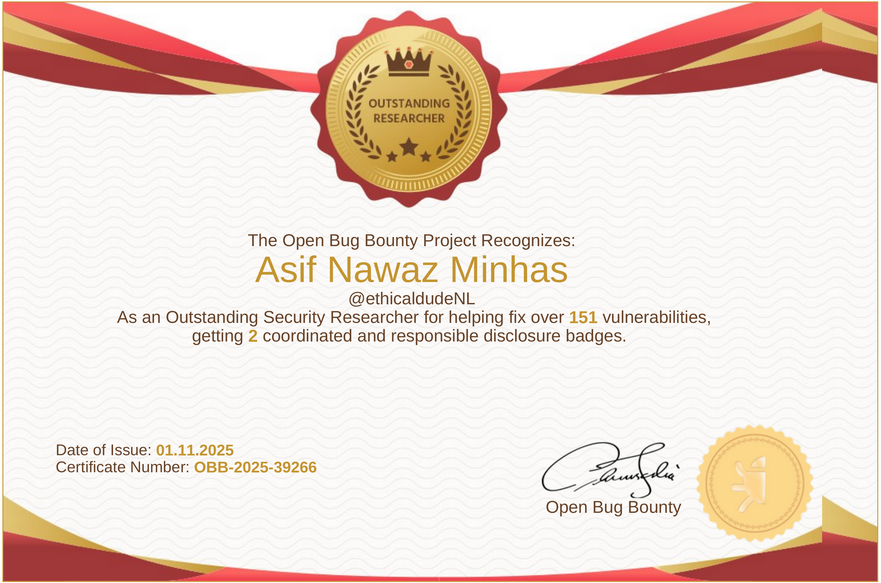
Certificate issued by Open Bug Bounty — Recognising 151+ verified fixes (2023)
Asif Minhas – Responsible Disclosure | Open Bug Bounty 2025 View Full Certificate (PDF)