Red Team vs Blue Team vs Purple Team: The Balance of Offense and Defense
Understand the relationship between Red, Blue, and Purple Teams in cybersecurity, how offense and defense work together to strengthen an organisation’s detection, response, and resilience.
Red Team vs Blue Team vs Purple Team
Modern cybersecurity is not a battle between offense and defense but it’s a conversation.
The colour team model provides a framework to understand how organisations assess, defend, and continuously improve their security posture through collaboration.
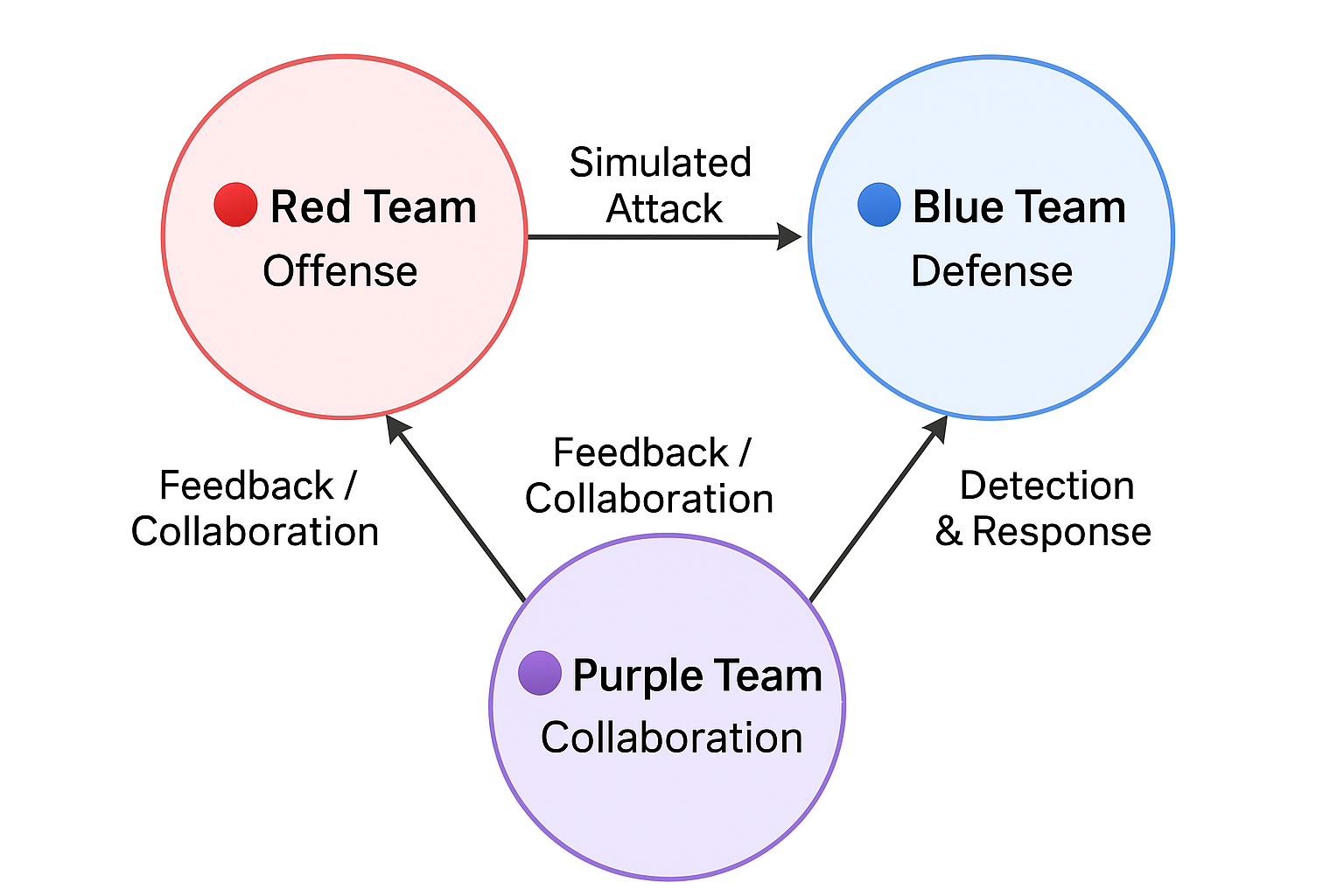
In cybersecurity, colour teams represent distinct but interconnected disciplines that, together, simulate real-world threats and strengthen an organisation’s readiness.
Each team has its own focus, but all share a common mission: building a security culture capable of learning, adapting, and improving with every engagement.
Red Team: Offense with Purpose
The Red Team acts as a sanctioned adversary, replicating the Tactics, Techniques, and Procedures (TTPs) of real attackers to measure how well an organisation detects, responds, and recovers.
- Primary Role: Simulate realistic attack scenarios under agreed-upon scope and authorization.
- Objective: Achieve mission-level goals, such as accessing sensitive data or escalating privileges, while remaining undetected.
- Key characteristics: Stealth and realism. A successful red team engagement tests more than technology: it evaluates human response, process maturity, and the effectiveness of defensive controls.
Unlike a traditional penetration test that enumerates vulnerabilities, red-team operations focus on impact, intent, and detection evasion, they actually mirror the decision making of genuine threat actors.
Blue Team: Defense in Depth
The Blue Team forms the defensive backbone of an organisation.
These analysts, engineers, and incident responders are responsible for identifying, containing, and mitigating attacks, both real and simulated.
- Primary Role: Detect, respond to, and recover from security incidents.
- Objective: Maintain operational continuity while strengthening defensive capabilities.
- Key Activities:
- Continuous monitoring through SIEM, EDR, and log analytics
- Threat-hunting and anomaly detection
- Forensic investigation and post-incident review
- Patch, configuration, and response automation
During a red-team exercise, the Blue Team’s success is measured by visibility and response speed, how quickly can they detect, isolate, and neutralize simulated threats before business impact occurs?
Purple Team — Collaboration in Action
The Purple Team is not a separate group of people; it’s a function, a mindset, and a bridge between offense and defense.
It ensures that insights from red-team operations directly translate into measurable blue-team improvements.
- Primary Role: Facilitate continuous collaboration between Red and Blue Teams.
- Objective: Transform every offensive technique into a defensive learning opportunity.
- How it Works:
- Red Teams share what techniques they used and why they succeeded.
- Blue Teams share what they detected and how they responded.
- Purple Teams document gaps, align MITRE ATT&CK mappings, and validate fixes through iterative testing.
Note: A Purple Team isn’t always a dedicated headcount. It can be:
- A function rotated among Red/Blue members
- A joint war room during engagements
- A shared backlog in Jira/Confluence with MITRE mappings
The goal isn’t a new org chart — it’s shared ownership of outcomes.
The result is a living feedback loop — a continuous improvement cycle that drives detection engineering, analytics tuning, and faster defensive maturity.
Insight from Mandiant: The Rise of AppSec in Red Teaming
“In intrusions where the initial intrusion vector was identified, 38% started with an exploit, up 6% from 2022. 28.7% of initial compromises came via public-facing web applications (MITRE T1190).”
— Mandiant M-Trends 2024
Source: Mandiant – Bridging the Gap: Elevating Red Team Assessments with Application Security Testing Traditional Red Teams often focus on network and infrastructure, but attackers don’t. They chain low-severity app flaws, reverse-engineer binaries, and exploit forgotten endpoints.
Mandiant’s 2024 research shows that integrating Application Security (AppSec) expertise into Red Team assessments dramatically improves realism and impact:
- Minimal access, maximum impact — no need for domain admin if a webhook gets you RCE.
- Vulnerability chaining — low/medium bugs become critical when combined.
- Custom exploits — zero-days are built when PoCs don’t exist.
- Diverse skill sets — AppSec + Red Team = creative, adversary-like attacks.
- Collaboration from day one — AppSec isn’t a phase; it’s woven throughout.
Source: Mandiant – Bridging the Gap: Elevating Red Team Assessments with Application Security Testing
Quick Reference: Red vs Blue vs Purple
| Aspect | Red Team | Blue Team | Purple Team |
|---|---|---|---|
| Mindset | Attacker | Defender | Collaborator |
| Success Metric | Undetected impact | Detection + containment speed | Verified detection improvement |
| Output | TTP report + evasion paths | Alert fidelity + MTTR | MITRE gap analysis + retest results |
| Tools | Cobalt Strike, Covenant, Sliver | Splunk, SentinelOne, osquery, Elastic | Atomic Red Team, Sigma, Jupyter |
| Feedback Loop | One-way (to Purple) | One-way (to Purple) | Bidirectional + iterative |
Beyond Competition: Co-Evolution
True resilience emerges when these disciplines stop operating in silos.
- Red Teams challenge assumptions and expose weaknesses.
- Blue Teams evolve detections and strengthen response capabilities.
- Purple Teams unify the process, ensuring lessons are shared and improvements are verified.
This co-evolution transforms cybersecurity from a pass-fail test into a measurable learning process — where every engagement refines both offensive realism and defensive depth.
Pro Tip: Build Adversary Emulation Plans
Move beyond one-off tests. Create annual adversary emulation plans (e.g., “Emulate FIN7”, “Emulate Volt Typhoon”) with:
- Pre-agreed TTPs (mapped to MITRE ATT&CK)
- Clear success criteria (e.g., “lateral movement undetected >48h = fail”)
- Blind vs. white-card testing modes
- Automated retesting via Atomic Red Team playbooks
This turns Purple Teaming into a program, not an event.
Why It Matters
Attackers collaborate far more than defenders often do.
Embracing the Red-Blue-Purple model closes that gap, enabling teams to share intelligence, standardise feedback, and build a repeatable testing framework that improves over time.
When done right, purple-team collaboration becomes a continuous security validation cycle:
Adversary simulation → Detection → Feedback → Improvement → Retest
It’s not about winning or losing — it’s about raising the collective bar for security readiness.
Your Move: Start Small, Win Big
Pick one technique from your last red-team engagement that went undetected.
Ask:
“Could Blue detect this in production — blind?”
If the answer is no, you’ve found your first Purple Team sprint.
Start there — every gap you close strengthens your overall resilience.